
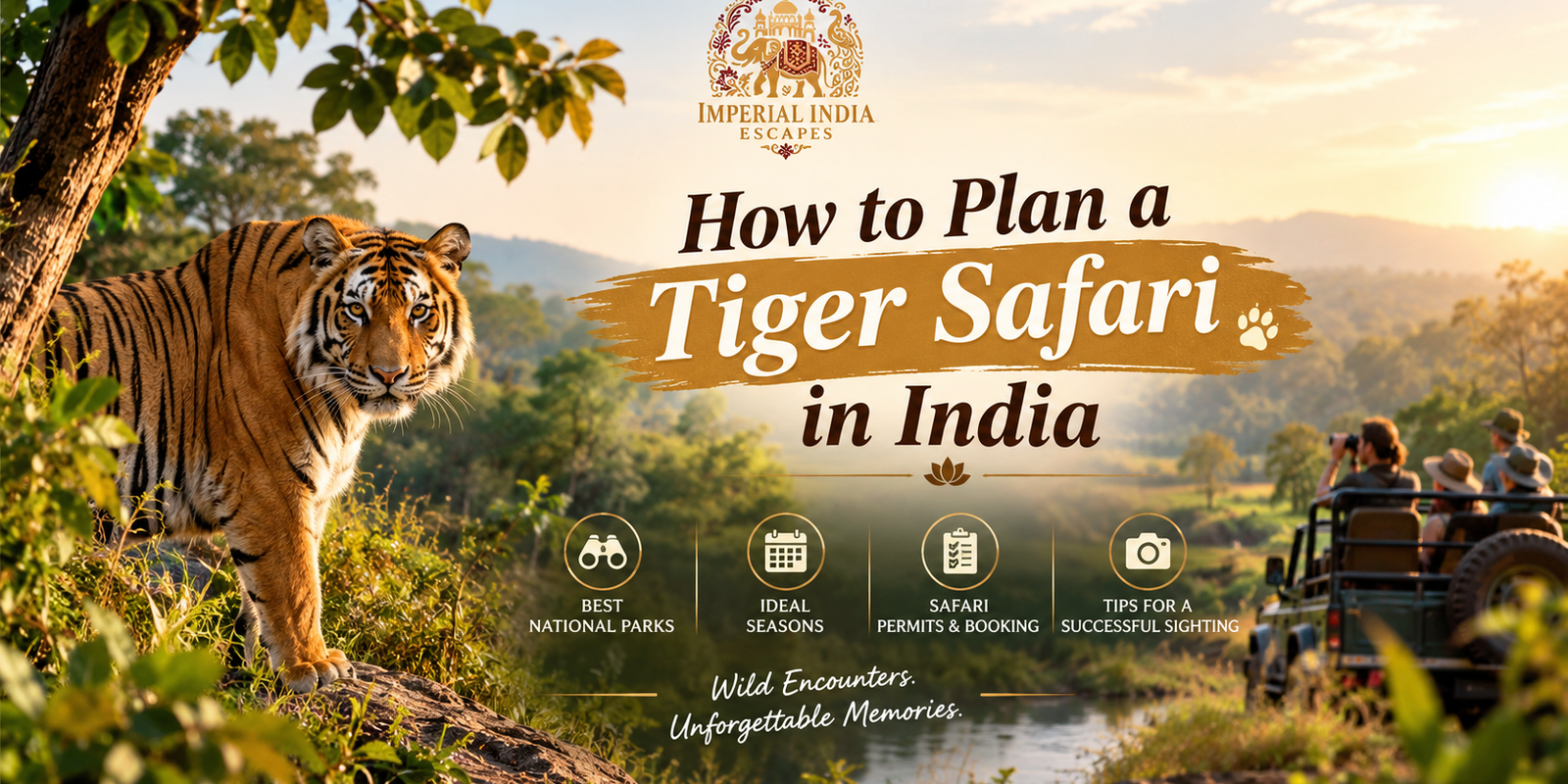
If you are dreaming of a tiger crossing a dusty forest track, the first question is usually “when should we go?” The second, often asked too late, is “have the permits sold out?”
Tiger safari planning in India is less about choosing a famous park and more about getting the logistics right. The season, the number of drives and the booking window all shape your chances. This guide explains how each one works, so you can plan with realistic expectations.
First, an honest word about sightings
No one can guarantee a tiger sighting, and you should be wary of anyone who does. Tigers are wild, wide-ranging and often hidden in dense forest. Even our own Madhya Pradesh safari itinerary says plainly that sightings are not guaranteed.
What you can do is improve the odds: travel in the right season, allow enough drives, and go with an experienced naturalist. A safari is also far more than one animal. Leopards, sloth bears, deer, birdlife and the forest itself make even a “tigerless” drive worthwhile.
When to go: understanding the safari season
The parks close during the monsoon
Most of India’s well-known tiger reserves close their core zones to visitors during the monsoon, roughly July to September.
- In Madhya Pradesh, which includes Bandhavgarh, Kanha, Pench, Satpura and Panna, core zones close for the monsoon and reopen in October, while buffer zones have remained open in recent years.
- Ranthambore in Rajasthan operates a season from October to June, closing over the monsoon months.
Exact dates can change from year to year, so check before booking.
Which months are best?
The season divides broadly into two halves:
| Period | Conditions | What to expect |
| October to February | Cooler, greener; mornings can be cold in open vehicles | Pleasant for combining with sightseeing; vegetation is thicker |
| March to June | Hot and dry; water sources shrink | Animals gather near water, which can help sightings; afternoons are very hot |
Many wildlife enthusiasts favour the hotter months for sightings, while travellers combining a safari with the Golden Triangle or Rajasthan often prefer the cooler season. Neither choice is wrong. Decide what matters more to you: comfort and a wider itinerary, or the best possible odds.
How permits and zones work
Safaris in India’s tiger reserves are tightly regulated, which protects the animals and limits crowding.
- Permits are required for each drive and are released in advance on official state portals. In Madhya Pradesh, bookings are made through the official MP Forest portal, which has opened the season’s permits around 120 days ahead.
- Each park is divided into zones. Your vehicle is assigned to a zone, usually when the permit is booked, and stays within it for the drive. Ranthambore, for example, has ten numbered zones.
- Vehicle numbers per zone are capped. Popular zones, especially on weekends and holidays, can fill early.
This is why timing matters. If your dates are fixed, particularly around Christmas, New Year or Easter, permits should be one of the first things arranged after the itinerary itself.
How many safari drives should you book?
Safaris run as morning and afternoon drives, each lasting a few hours. One drive gives you a glimpse; several give you a real chance.
As a planning guide:
- Two nights, three or four drives: a sensible minimum for one park.
- Three nights, five or six drives: better odds and a more relaxed pace.
- Two parks: worth considering for dedicated wildlife travellers, since each park has a different landscape and character.
Morning drives start early, with entry around 6am in Madhya Pradesh in October and November according to the MP Forest season timetable. Build in time to rest between drives.
A sample two-night safari stay
Here is how a typical two-night stay at a tiger reserve can be paced. Exact timings vary by park and month.
| Day | Morning | Afternoon | Evening |
| Day 1 | Travel to the lodge (by road or from the nearest airport or railway station) | Check in, rest, first afternoon drive if timings allow | Briefing with your naturalist |
| Day 2 | Early morning drive | Rest during the heat of the day; afternoon drive | Lodge dinner, review of sightings |
| Day 3 | Final early morning drive | Depart after a late breakfast | — |
This pattern gives you three or four drives without exhausting early starts on every day. If you add a third night, you gain two more drives and a rest morning if you need one.
Jeep or canter?
Two vehicle types are common:
| Jeep (often called a Gypsy) | Canter | |
| Size | Small, around six passengers | Larger open vehicle, around 20 passengers |
| Experience | More flexible and quieter; better for photography | Shared, busier; can be noisier |
| Availability | Limited, so book early | More seats, sometimes easier at short notice |
Most travellers on a private trip prefer a jeep, and a private jeep booked just for your group gives you most control over the experience.
Choosing where to go
India has many tiger reserves. For a first safari, the choice usually comes down to how it fits the rest of your trip:
- Ranthambore sits between Agra and Jaipur and combines naturally with the Golden Triangle. See our Golden Triangle with Ranthambore journey.
- Madhya Pradesh’s reserves, including Bandhavgarh and Kanha, suit travellers who want a wildlife-focused trip.
We compare the parks in detail in a separate guide. For a broader view of India’s wildlife regions, see our wildlife journeys page.
Practical tips for safari days
- Dress in muted colours and layers. Winter mornings in an open vehicle can be surprisingly cold.
- Bring a scarf or buff for dust, plus sun protection for afternoon drives.
- Binoculars make a real difference, even for non-photographers.
- Keep noise low. It helps everyone in your zone.
- Follow the naturalist’s and driver’s instructions. Park rules are strict, for good reason.
Frequently asked questions
When is the best time for a tiger safari in India? The safari season generally runs from October to June, with core zones closed during the monsoon. Hotter months from March to June are often cited for better sightings as animals gather near water. The cooler months are more comfortable and combine well with sightseeing.
How many safaris do you need to see a tiger? There is no fixed number, and sightings are never guaranteed. Booking three or four drives over two nights in one park gives a reasonable chance, and five or six drives over three nights improves the odds further.
How far in advance should I book a tiger safari? As early as your dates are fixed. Permits are released on official state portals ahead of time, around 120 days ahead in Madhya Pradesh, and popular zones and dates can sell out quickly.
Are tiger safaris suitable for children? Many families enjoy safaris, but drives start early and involve several hours in an open vehicle. Check each park’s rules on minimum ages before booking, and choose a lodge with space to relax between drives.
Explore our private wildlife journeys
A well-planned tiger safari is one of the most rewarding experiences in India, whether or not a tiger appears on cue. The right season, enough drives and permits secured early give you the best chance.
Explore our Madhya Pradesh wildlife and heritage journey, or talk to our team about adding a safari to your India itinerary.